
Description
Buy BPC-157 10mg | High Purity Research Peptide Europe | EU Research Peptides
Welcome to euresearchpeptides.com — your trusted source for premium, laboratory-grade research peptides in Europe. Our BPC-157 10mg peptide (Body Protection Compound 157) is a synthetically produced pentadecapeptide consisting of 15 amino acids, derived from a protective protein naturally found in human gastric juice. This research peptide has garnered significant attention in the scientific community for its extensive cytoprotective, anti-inflammatory, and regenerative properties observed in preclinical studies. buy BPC-157 10mg Europe
What Is BPC-157 10mg?
BPC-157 is a stable gastric pentadecapeptide with the amino acid sequence Gly-Glu-Pro-Pro-Pro-Gly-Lys-Pro-Ala-Asp-Asp-Ala-Gly-Leu-Val. It represents a fragment of the Body Protective Compound (BPC) protein originally discovered in gastric juice. Unlike full-length proteins, this synthetic peptide is designed for research applications investigating tissue healing, angiogenesis modulation, and gut-brain axis interactions. buy BPC-157 10mg Europe
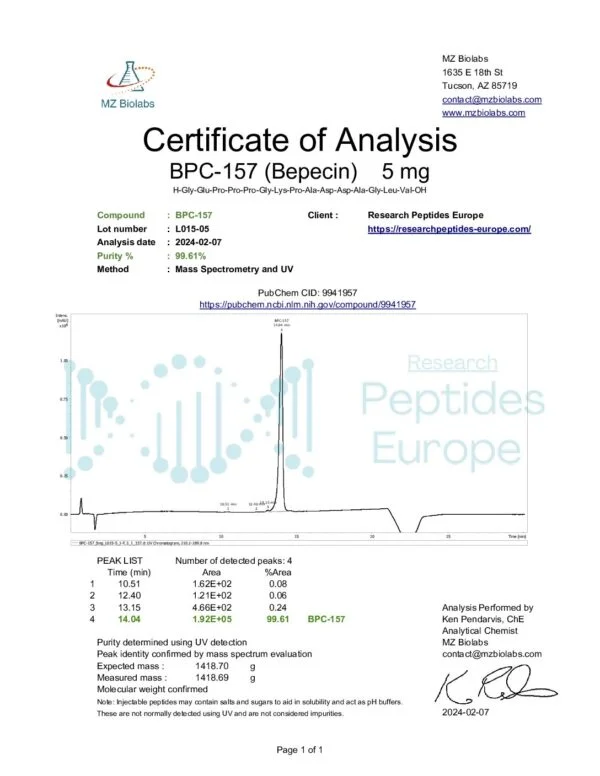
Research has demonstrated that BPC-157 exhibits diverse biological activities, including increasing cell migration and F-actin formation in primary rat tendon fibroblasts at a concentration of 2 µg/ml. This peptide is strictly intended for laboratory research use only and is not for human consumption. Our BPC-157 10mg is manufactured using solid-phase peptide synthesis (SPPS) and purified via high-performance liquid chromatography (HPLC) to achieve purity exceeding 99%. buy BPC-157 10mg Europe
How BPC-157 Works: Mechanism of Action
In research models, BPC-157 exerts its biological effects through several well-characterized mechanisms:
Angiogenesis Modulation: BPC-157 promotes angiogenesis (formation of new blood vessels) in injured tissues while simultaneously opposing pathological neovascularization, such as that observed in corneal injury models. This dual action distinguishes BPC-157 from standard angiogenic agents.
Nitric Oxide System Regulation: BPC-157 uniquely modulates the nitric oxide (NO) system, increasing or decreasing NO levels as needed while always counteracting free radical formation. This regulatory capacity allows BPC-157 to maintain healing functions while preventing NO-mediated tissue damage.
Neurotransmitter Pathway Interaction: Research indicates BPC-157 interacts with multiple neurotransmitter systems, including dopaminergic, serotonergic, GABAergic, and adrenergic pathways. This multimodal action enables BPC-157 to counteract disturbances across various receptor types, including blockade, over-activity, depletion, and tolerance states.
Gut-Brain Axis Modulation: Preclinical evidence suggests BPC-157 influences the gut-brain axis (GBA), affecting neural and gastrointestinal functions. Studies demonstrate neuroprotective effects, regulation of inflammation, and influence on mood and cognition in animal models.
Research Applications
| Research Area | Application |
|---|---|
| Musculoskeletal Healing | Studies on tendon, ligament, muscle, and bone repair; accelerated wound healing in avascular tissues |
| Gastrointestinal Research | Inflammatory bowel disease models, ulcer healing, mucosal protection, leaky gut syndrome |
| Neuroscience | Neuroprotection in Parkinson’s disease models, spinal cord injury, traumatic brain injury, peripheral nerve damage |
| Inflammatory Conditions | Rheumatoid arthritis models, reduced paw swelling, bone erosion, and mononuclear cell infiltration |
| Cardiovascular Research | Blood flow enhancement, angiogenesis in ischemic tissues, counteraction of QTc prolongation |
Performance Benefits for Research
| Attribute | Specification | |
|---|---|---|
| Purity | >99% (HPLC verified, MS confirmed) | |
| Molecular Formula | C62H98N16O22 | |
| Molecular Weight | 1419.54 g/mol | |
| CAS Number | 137525-51-0 | 1628202-19-6 |
| Sequence | Gly-Glu-Pro-Pro-Pro-Gly-Lys-Pro-Ala-Asp-Asp-Ala-Gly-Leu-Val | |
| Appearance | White to off-white lyophilized powder | |
| Salt Form | Acetate | |
| Endotoxin Level | <0.05 EU/mg | |
| Storage | Lyophilized: -20°C or below; Reconstituted: 2-8°C |
Solubility Profile
BPC-157 exhibits good solubility in aqueous solutions:
-
Primary solvent: Sterile water or bacteriostatic water
-
Alternative solvents: 0.9% saline solution
-
Reconstitution guideline: For a 10 mg vial, add 1 mL of bacteriostatic water yields approximately 10 mg/mL concentration; add 2 mL yields 5 mg/mL; add 3 mL yields 3.33 mg/mL
Stability and Storage Recommendations
| Condition | Storage Method |
|---|---|
| Lyophilized Powder | Store at -20°C (-4°F) or below, protected from light and moisture |
| Reconstituted Solution | Refrigerate at 2-8°C (35.6-46.4°F), use within 30 days |
| Long-term Stability | Keep lyophilized and frozen; avoid repeated freeze-thaw cycles |
| Shelf Life | 24 months when stored properly in lyophilized form |
Reconstitution Guidelines
For a 10 mg vial of BPC-157:
-
Add 1 mL bacteriostatic water for 10 mg/mL concentration
-
Add 2 mL for 5 mg/mL concentration
-
Add 3 mL for 3.33 mg/mL concentration
-
Allow peptide to dissolve completely; gently swirl — do not shake
Quality Standards at EU Research Peptides
Our BPC-157 10mg is manufactured under strict quality control protocols:
-
Synthesis: Solid-phase peptide synthesis (SPPS) with Fmoc chemistry
-
Purification: HPLC purification to >99% purity
-
Verification: Mass spectrometry (MS) confirmation of molecular weight
-
Quality Control: Each batch includes Certificate of Analysis (COA) with HPLC chromatogram and MS spectrum
-
Facility: ISO-classified cleanroom manufacturing
Known Research Applications (Citations)
Preclinical studies have documented BPC-157 activity across multiple research domains:
| Application | Model | Key Finding | Citation |
|---|---|---|---|
| Tendon Healing | Rat tendon fibroblasts | Increased cell migration and F-actin formation at 2 µg/ml | |
| Rheumatoid Arthritis | CFA-induced rat model | Reduced paw swelling, bone erosion, mononuclear cell infiltration (0.01 and 10 µg/kg IP) | |
| Gastric Ulcer | Indomethacin/aspirin/diclofenac-induced rats | Reduced lesion size | |
| Parkinson’s Disease | MPTP-induced mouse model | Decreased catalepsy duration, reduced tremor severity | |
| Corneal Healing | Rat corneal ulcer model | Maintained transparency, opposed neovascularization (2 ng/mL and 2 µg/mL) | |
| Spinal Cord Injury | Rat model | Recovery of motor function, neuroprotection | |
| Inflammatory Bowel Disease | Rat ileoileal anastomosis | Improved healing of intestinal anastomosis |
Handling Protocols
For research use only. Proper handling ensures experimental integrity:
-
Allow vials to reach room temperature before opening to minimize condensation
-
Reconstitute by injecting diluent slowly down the vial wall; avoid foaming
-
Gently swirl or roll until fully dissolved — do not shake
-
Label with date, concentration, and lot number
-
Store reconstituted peptide at 2-8°C and use within 30 days
Safety Considerations
Researchers should be aware of the following safety information:
-
Research Use Only: BPC-157 is not approved by the European Medicines Agency (EMA) and cannot be prescribed as a pharmaceutical
-
No Human Consumption: This product is strictly for laboratory research purposes only; not for human therapeutic use
-
WADA Status: BPC-157 was banned by the World Anti-Doping Agency (WADA) in 2022 and is prohibited in competitive sports
-
Safety Profile: Research indicates a favorable safety profile with LD1 not achieved in animal studies
-
Handling Precautions: Use appropriate personal protective equipment (PPE); follow institutional biosafety guidelines
-
Disposal: Dispose of materials according to local regulations for chemical waste
Why Researchers Choose EU Research Peptides
European-Based Operations: We are strategically located in the EU, ensuring fast, reliable shipping across Europe without customs delays.
Premium Quality: Every peptide batch undergoes rigorous third-party testing for purity, stability, and endotoxin levels.
Research Compliance: All products are labeled “For Research Use Only” and comply with EU chemical regulations.
Technical Support: Our team provides comprehensive documentation including COAs, MSDS, and reconstitution protocols.
Competitive Pricing: Volume discounts available for research institutions and bulk orders.
👉 Explore our complete catalog of research peptides at our official homepage.
Frequently Asked Questions (FAQ)
What is BPC-157 peptide?
BPC-157 (Body Protection Compound 157) is a synthetic pentadecapeptide consisting of 15 amino acids with the sequence Gly-Glu-Pro-Pro-Pro-Gly-Lys-Pro-Ala-Asp-Asp-Ala-Gly-Leu-Val. It is derived from a protective protein found in human gastric juice and is studied for its cytoprotective, anti-inflammatory, and regenerative properties in research settings.
What is the molecular formula and weight of BPC-157?
The molecular formula is C62H98N16O22 with a molecular weight of 1419.54 g/mol.
What is the CAS number for BPC-157?
BPC-157 has two associated CAS numbers: 137525-51-0 and 1628202-19-6.
What purity level does EU Research Peptides offer for BPC-157 10mg?
Our BPC-157 10mg peptide is tested at >99% purity by HPLC with mass spectrometry confirmation. Each batch includes a Certificate of Analysis (COA) with detailed purity data.
How should I store BPC-157?
Lyophilized BPC-157 should be stored at -20°C or below, protected from light and moisture. After reconstitution, refrigerate at 2-8°C and use within 30 days. Avoid repeated freeze-thaw cycles.
Is BPC-157 soluble in water?
Yes, BPC-157 is soluble in sterile water, bacteriostatic water, and saline solution.
What is the recommended reconstitution protocol for BPC-157 10mg?
For a 10 mg vial: add 1 mL of bacteriostatic water to achieve 10 mg/mL concentration; add 2 mL for 5 mg/mL; add 3 mL for 3.33 mg/mL. Gently swirl until fully dissolved — do not shake.
What are the primary research applications for BPC-157?
BPC-157 is studied in musculoskeletal healing (tendons, ligaments, muscles), gastrointestinal research (IBD, ulcers, mucosal protection), neuroscience (neuroprotection, Parkinson’s models, spinal cord injury), inflammatory conditions (rheumatoid arthritis), and cardiovascular research.
Does BPC-157 have anti-inflammatory effects in research models?
Yes, research demonstrates that BPC-157 reduces paw swelling, bone erosion, and inflamed joint mononuclear cell infiltration in rat models of rheumatoid arthritis induced by complete Freund’s adjuvant (CFA) at doses of 0.01 and 10 µg/kg intraperitoneally.
What is the legal status of BPC-157 in the EU?
BPC-157 is not approved by the European Medicines Agency (EMA) and cannot be prescribed as a pharmaceutical. It is sold as a research chemical for laboratory use only, not for human consumption.
Is BPC-157 banned by WADA?
Yes, the World Anti-Doping Agency (WADA) banned BPC-157 in 2022, classifying it as an S0 substance (a substance with no approved medical use that is prohibited in sport).
What is the safety profile of BPC-157 in research?
Preclinical research indicates a favorable safety profile with LD1 not achieved in animal studies. BPC-157 has demonstrated beneficial effects across multiple animal models without significant observed toxicity.
Can I purchase BPC-157 10mg in bulk?
Yes, EU Research Peptides offers volume discounts for bulk orders. Contact our customer service team for customized quotes.
How long does shipping take within Europe?
Standard shipping within the EU takes 3-5 business days. Express shipping options are available for urgent research needs.
What documentation is provided with each order?
Each order includes a Certificate of Analysis (COA), material safety data sheet (MSDS), and reconstitution protocol.


Reviews
There are no reviews yet.