
Description
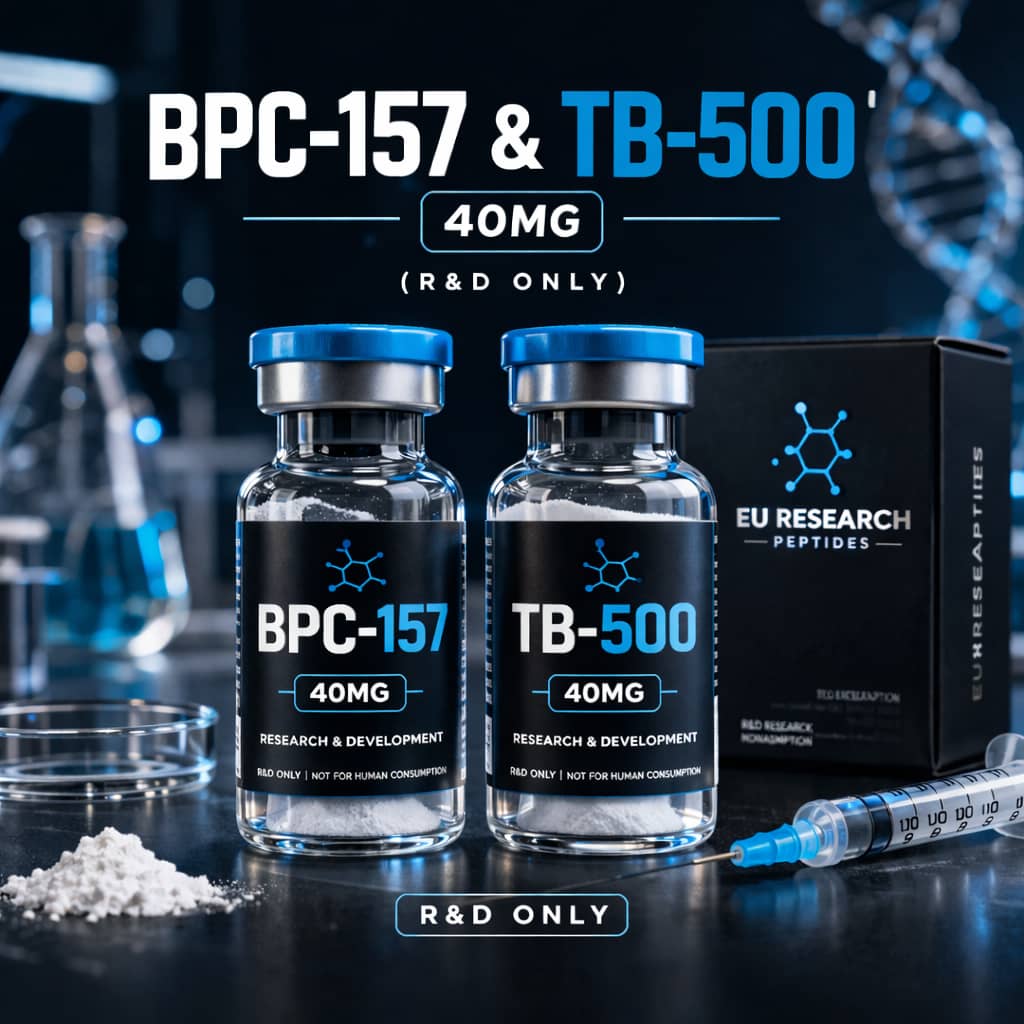
Buy BPC-157 & TB-500 40mg Blend Peptide Europe Online
Welcome to euresearchpeptides.com — your trusted source for premium, laboratory-grade research peptides in Europe. Our BPC-157 & TB-500 40mg blend combines two of the most widely studied regenerative peptides in a single, precisely formulated vial for advanced research applications. buy BPC-157 TB-500 40mg blend Europe
What Is the BPC-157 & TB-500 Blend?
This 40mg research peptide blend contains 20mg of BPC-157 and 20mg of TB-500 in a single lyophilized vial. BPC-157 (Body Protection Compound-157) is a synthetic pentadecapeptide consisting of 15 amino acids, originally derived from a protective protein fragment found in human gastric juice. TB-500 is a synthetic variant of thymosin beta-4 (Tβ4), a peptide involved in cellular regeneration and tissue repair processes. buy BPC-157 TB-500 40mg blend Europe
Researchers study this combination in preclinical models to explore the potential synergistic effects on angiogenesis signaling, connective tissue pathways, and cellular regeneration. Both peptides are strictly intended for laboratory research use only and are not for human consumption. buy BPC-157 TB-500 40mg blend Europe
How It Works: Mechanisms of Action
In research models, BPC-157 and TB-500 exert their biological effects through distinct yet complementary mechanisms.
BPC-157 Mechanism:
BPC-157 is hypothesized to influence multiple biological pathways that contribute to cellular homeostasis and tissue recovery. Research suggests it engages with angiogenesis pathways, potentially promoting the formation of new blood vessels — a process critical for providing oxygen and nutrients to damaged tissues. The peptide may modulate the expression of growth factors including vascular endothelial growth factor (VEGF) and transforming growth factor-beta (TGF-β), both integral to tissue regeneration. BPC-157 may also support cellular migration and proliferation while influencing fibroblast activity in the synthesis of extracellular matrix components and collagen deposition.
TB-500 Mechanism:
TB-500 replicates many bioactive properties attributed to thymosin beta-4. Its most notable property is the potential to interact with actin, a key protein in cytoskeletal organization. By binding to actin, TB-500 is hypothesized to promote cell migration—a critical component of tissue regeneration. Research indicates TB-500 may modulate angiogenesis by impacting endothelial cell activity, encouraging the formation of new blood vessels in damaged tissues. The peptide may also engage with growth factors like fibroblast growth factor (FGF) and platelet-derived growth factor (PDGF) .
Synergistic Potential:
While both peptides exhibit distinct properties, their overlapping actions in angiogenesis and tissue repair suggest a blend may present unique opportunities for research into supported tissue repair mechanisms. The combination is studied for potential amplified effects on blood vessel formation, anti-inflammatory pathways, and cellular regeneration compared to either peptide alone.
Research Applications
| Research Area | Application |
|---|---|
| Soft Tissue Repair | Studies on tendon, ligament, and muscle recovery pathways |
| Angiogenesis Research | Investigation of blood vessel formation and endothelial cell activity |
| Gastrointestinal Research | Models of mucosal healing and intestinal barrier function |
| Dermatology Studies | Research on wound closure, skin regeneration, and scar reduction |
| Orthopedic Research | Preclinical models of joint, bone, and connective tissue recovery |
Performance Benefits for Research
| Attribute | Specification |
|---|---|
| Peptide Content | BPC-157 20mg + TB-500 20mg (Total 40mg) |
| Purity | >99% (HPLC verified, MS confirmed) |
| BPC-157 Sequence | H-Gly-Glu-Pro-Pro-Pro-Gly-Lys-Pro-Ala-Asp-Asp-Ala-Gly-Leu-Val-OH |
| BPC-157 Molecular Formula | C62H98N16O22 |
| BPC-157 Molecular Weight | 1419.56 g/mol |
| TB-500 Sequence | Ac-Ser-Asp-Lys-Pro-Asp-Met-Ala-Glu-Ile-Glu-Lys-Phe-Asp-Lys-Ser-Lys-Leu-Lys-Lys-Thr-Glu-Thr-Gln-Glu-Lys-Asn-Pro-Leu-Pro-Ser-Lys-Glu-Thr-Ile-Glu-Gln-Glu-Lys-Gln-Ala-Gly-Glu-Ser-OH |
| TB-500 Molecular Formula | C212H350N56O78S |
| TB-500 Molecular Weight | 4963.61 g/mol |
| CAS Number (BPC-157) | 137525-51-0 |
| CAS Number (TB-500) | 885340-08-9 |
| Appearance | White to off-white lyophilized powder |
| Endotoxin Level | <0.05 EU/mg |
| Salt Form | Acetate / TFA |
Solubility Profile
Recommended reconstitution protocol:
| Diluent Volume | Total Concentration | Per Peptide Concentration |
|---|---|---|
| 2.0 mL bacteriostatic water | 20 mg/mL total | 10 mg/mL BPC-157 + 10 mg/mL TB-500 |
| 3.0 mL bacteriostatic water | 13.33 mg/mL total | 6.67 mg/mL BPC-157 + 6.67 mg/mL TB-500 |
| 4.0 mL bacteriostatic water | 10 mg/mL total | 5 mg/mL BPC-157 + 5 mg/mL TB-500 |
For accurate dosing in research protocols using a U-100 insulin syringe at 3 mL reconstitution: 1 unit = 0.01 mL ≈ 66.7 mcg total blend (approximately 33.3 mcg of each peptide).
Always inject diluent slowly down the vial wall, aiming for the glass rather than directly onto the lyophilized powder to prevent clumping or peptide degradation. Gently swirl or roll until fully dissolved — do not shake.
Stability and Storage Recommendations
| Condition | Storage Method |
|---|---|
| Lyophilized Powder | Store at -20°C (-4°F) or below, protected from light and moisture |
| Reconstituted Solution | Refrigerate at 2-8°C (35.6-46.4°F), use within 14-30 days |
| Long-term Stability | Keep lyophilized and frozen; avoid repeated freeze-thaw cycles |
| Shelf-Life | 24+ months when stored properly in lyophilized form |
Reconstitution Guidelines
For the 40mg blend vial (20mg BPC-157 + 20mg TB-500):
Option 1 (Higher Concentration):
-
Add 2.0 mL bacteriostatic water
-
Final concentration: 20 mg/mL total (10 mg/mL of each peptide)
-
For 100 mcg of each peptide: draw 0.01 mL (10 units on U-100 syringe)
Option 2 (Standard Research Protocol):
-
Add 3.0 mL bacteriostatic water
-
Final concentration: 13.33 mg/mL total (6.67 mg/mL of each peptide)
-
For 250 mcg of each peptide: draw 0.0375 mL (approximately 37.5 units)
Option 3 (Lower Concentration for Precise Dosing):
-
Add 4.0 mL bacteriostatic water
-
Final concentration: 10 mg/mL total (5 mg/mL of each peptide)
-
For 250 mcg of each peptide: draw 0.05 mL (50 units)
Proper Handling Protocols
For research use only. Proper handling ensures experimental integrity:
-
Allow vials to reach room temperature before opening to minimize condensation
-
Clean rubber stopper with alcohol swab before piercing
-
Reconstitute by injecting diluent slowly down the vial wall; avoid foaming
-
Gently swirl or roll until fully dissolved — do not shake
-
Label with reconstitution date, concentration, and lot number
-
Store reconstituted peptide at 2-8°C and use within 14 days for optimal stability
-
For subcutaneous injection in animal models: use 27–30-gauge insulin syringe, 5/16-inch length
Quality Standards at EU Research Peptides
Our BPC-157 & TB-500 blend is manufactured under strict quality control protocols:
-
Synthesis: Solid-phase peptide synthesis (SPPS) with Fmoc chemistry
-
Purification: HPLC purification to >99% purity
-
Verification: Mass spectrometry (MS) confirmation of molecular weight
-
Quality Control: Each batch includes Certificate of Analysis (COA) with HPLC chromatogram and MS spectrum
-
Facility: ISO-classified cleanroom manufacturing
Why Researchers Choose EU Research Peptides
European-Based Operations: We are strategically located in the EU, ensuring fast, reliable shipping across Europe without customs delays.
Premium Quality: Every peptide batch undergoes rigorous third-party testing for purity, stability, and endotoxin levels. Both BPC-157 and TB-500 have been extensively studied in preclinical models, with research indicating potential applications in tissue repair, angiogenesis, and regenerative biology.
Research Compliance: All products are labeled “For Research Use Only” and comply with EU chemical regulations.
Technical Support: Our team provides comprehensive documentation including COAs, MSDS, and reconstitution protocols.
Competitive Pricing: Bulk discounts available for research institutions and volume orders. The 40mg blend offers exceptional value compared to purchasing peptides separately.
👉 Explore our complete catalog of research peptides at our official homepage.
Safety Considerations
BPC-157 and TB-500 are intended for laboratory research purposes only. They are not for human consumption, therapeutic use, or veterinary applications. Researchers should:
-
Follow institutional biosafety guidelines
-
Use appropriate personal protective equipment (PPE)
-
Handle all peptides with sterile technique
-
Consult a licensed healthcare provider before any experimental use
-
Understand that safety and efficacy are not well established for human use
-
Dispose of materials according to local regulations
Frequently Asked Questions (FAQ)
What is BPC-157?
BPC-157 (Body Protection Compound-157) is a synthetic pentadecapeptide consisting of 15 amino acids, originally derived from a protective protein fragment found in human gastric juice. It is studied in preclinical research for its potential effects on angiogenesis, tissue repair, and cellular regeneration.
What is TB-500?
TB-500 is a synthetic variant of thymosin beta-4 (Tβ4), a peptide involved in cellular regeneration and tissue repair processes. It is studied for its potential to interact with actin and promote cell migration and angiogenesis.
Why research BPC-157 and TB-500 together?
Researchers study these peptides together because their distinct, yet complementary mechanisms may produce synergistic effects. Both influence angiogenesis pathways, and their combination is hypothesized to offer a more comprehensive approach to tissue repair research compared to either peptide alone.
What is the purity of your BPC-157 & TB-500 blend?
Our blend is tested at >99% purity by HPLC with mass spectrometry confirmation. Each batch includes a Certificate of Analysis (COA) with detailed purity data.
How should I reconstitute the 40mg blend?
For a 40mg vial (20mg + 20mg), common protocols include: 2mL bacteriostatic water yields 20mg/mL total; 3mL yields 13.33mg/mL total; 4mL yields 10mg/mL total. Always inject diluent slowly down the vial wall and swirl gently to dissolve.
What is the typical research dosage range for these peptides?
Research protocols vary. Typical daily ranges studied in preclinical models include 250-500 mcg of BPC-157 and 250-500 mcg of TB-500. Researchers should determine appropriate concentrations based on their specific experimental design and endpoints.
How should I store the peptides?
Lyophilized peptides should be stored at -20°C or below, protected from light and moisture. After reconstitution, refrigerate at 2-8°C and use within 14-30 days.
What are the primary research applications for this blend?
Primary research areas include soft tissue repair studies (tendons, ligaments, muscles), angiogenesis research, gastrointestinal mucosal healing, dermatology studies (wound closure, scar reduction), and orthopedic research.
Is this product for human use?
No. This product is strictly for laboratory research and educational purposes only. It is not for human consumption, therapeutic use, or veterinary applications.
Do you ship to my country in Europe?
We ship to all EU countries including Germany, France, Netherlands, Spain, Italy, Belgium, Austria, Sweden, Denmark, Finland, Poland, and more. Contact our customer service team for shipping inquiries.
What documentation is provided with each order?
Each order includes a Certificate of Analysis (COA), material safety data sheet (MSDS), and reconstitution protocol.
Are there any safety concerns with handling these peptides?
Standard laboratory safety practices should be followed, including the use of personal protective equipment (PPE) and sterile technique. Consult the MSDS for complete safety information.


Reviews
There are no reviews yet.